Tuesday, April 7, 2015

Pictures of Messier 22 From the Hubble Space Teliscope


 This is a close-up of the central region of the globular cluster Messier 22, as observed by the NASA/ESA Hubble Space Telescope. Image credit: ESA / Hubble / NASA.

 Messier 22, a globular space cluster, was recently imaged by the Hubble Space Telescope in striking fashion. It is about 10,400 light years away from earth, and is located in the constellation Sagittarius. It was the first globular cluster discovered in 1965. Globular clusters are thought to be from the early formation of the universe, with all stars in the clusters being over 10 billion years old. Globular clusters are different from the rest of the galaxies because they are simply condensed clusters of stars that have not undergone change for billions of years. An interesting fact about this cluster is that it has six planet sized objects that are not orbiting any sun. The Cluster is also home to two black holes.   


"Hubble Space Telescope Views Globular Cluster Messier 22." Breaking Science News SciNewscom. N.p., n.d. Web. 06 Apr. 2015.

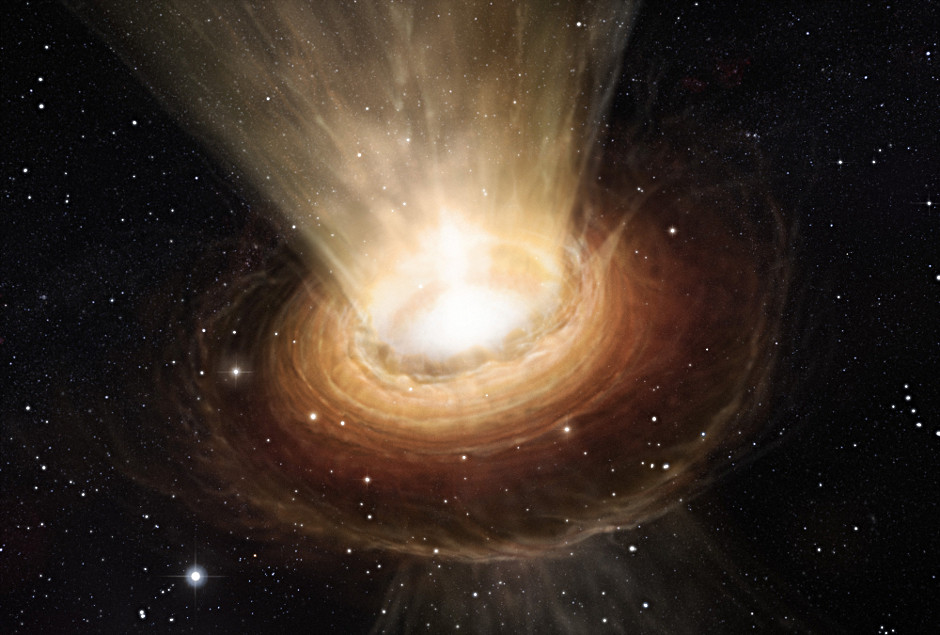
The Inside of a Black Hole

An artist’s impression shows the surroundings of a supermassive black hole at the heart of the active galaxy NGC 3783 in the southern constellation of Centaurus. A new University at Buffalo study finds that information is not lost once it has entered a black hole. Credit: ESO/M. KornmesserEver since the creation of quantum mechanics, Black holes were seen as vast unknown entities that sucked up everything around them. Whatever entered the black hole was thought to be gone forever, which was unique and incredible in the world of science. Now Dejan Stojkovic, professor of physics at the University of Buffalo, has released a new study that indicates that the mass doesn't disappear but rather exists outside our perception. This finding was made because scientists observed the particle interactions going to and from the black hole. These interactions were thought to be unimportant because of their small scale, but after Dejan studied the data more closely, the particle interactions added up, changing the information released from the black hole, giving an indication of the size, energy etc. This is important in human ability to comprehend black holes and their mystery.

"Black Holes May Reveal What Lies within." Astronomy Now. N.p., n.d. Web. 06 Apr. 2015.